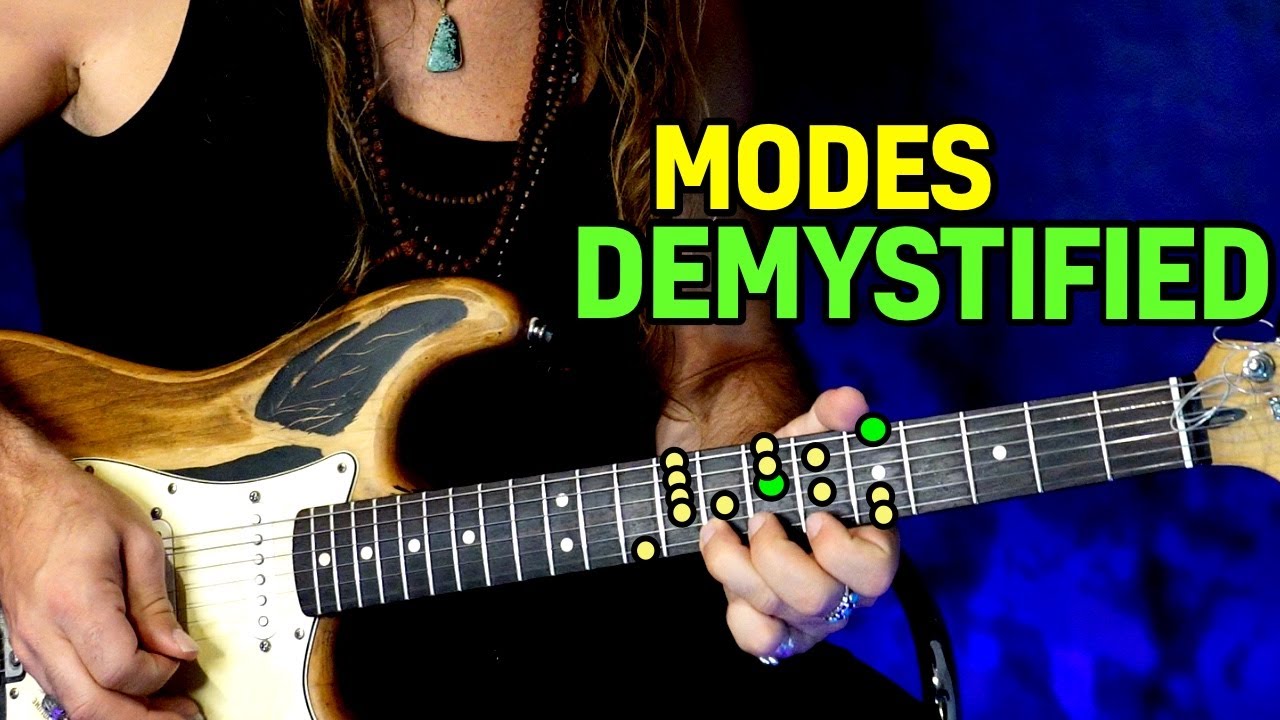
Change The Way You Think About MODES
Change The Way You Think About Modes: A Practical Guide to Understanding Guitar Modes
If you've spent any time in guitar forums or scrolling through YouTube, you've probably encountered the topic that confuses more guitarists than almost any other: modes. It's one of the most discussed yet misunderstood concepts in music theory. But here's the real question: do you want to understand modes theoretically, or do you want to actually feel them when you play?
There's a massive disconnect between how modes are typically explained and how they actually sound when you're playing over chord progressions. The good news? Once you shift your perspective, modes become intuitive, practical, and genuinely useful for your playing. Instead of memorizing interval formulas, you'll learn to recognize the emotional colors that modes bring to music and use them naturally on the fretboard.
Understanding the Three Major Modes and Their Emotional Colors
Let's start with what Ulrich Ellison calls the "colors" of modes. Rather than drowning in theory, focus on how each mode feels and sounds.
Ionian (Major Scale): This is your foundational sound—sunny, open, light, and friendly. When you play Ionian, you're hearing the familiar major scale that forms the basis of most popular music. It's the reference point from which all other modes differ.
Lydian: Think of this as the "mysterious sister" of Ionian. With just one note changed (a raised fourth), Lydian opens up an entirely new universe of sound. It feels eclectic, transcendent, almost otherworldly. The tension created by the sharp four resolving to stable notes like the fifth or third gives this mode its distinctive character. This is where things get interesting—you're learning to hear and resolve tension, not just memorizing scales.
Mixolydian (The Blues Major Scale): This is where many guitarists finally connect with modes because Mixolydian sounds bluesy and gutsy. Interestingly, it also carries strong Indian musical qualities, which is why jazz fusion legends like John McLaughlin and Jeff Beck used it so extensively. When you hear that bluesy, slightly Indian quality, you're experiencing the emotional power of modal playing—something far more valuable than knowing its theoretical construction.
The Three Minor Modes: Exploring Darker Territory
Once you've internalized the major modes, the minor modes expand your emotional palette in equally powerful ways. The natural minor scale gives you that melancholic, slightly dark, subdued feeling that resonates with so many guitarists. It's beautifully introspective without being completely sorrowful.
The key to truly mastering modes is training your ear and your fingers to recognize these emotional differences. Put on a drone in your target key, play through each mode, and really sit with how it feels. Don't just run scales mechanically—actually listen to the tension and resolution. Notice which notes feel stable and which ones demand movement. This is how you develop modal intuition rather than just modal knowledge.
The Real Secret: Discover Moods, Not Modes
Here's a concept that transforms your approach to modes forever: as Duke Ellington once said, "It's all about the mood and not the modes." This wisdom completely reframes how you should practice and apply modes to your playing.
Instead of asking "What mode am I supposed to use here?" start asking "What emotional color do I want to hear?" When you recognize that a chord progression is shifting colors—moving away from a single key center into different harmonic territory—you'll naturally reach for the right modal sounds to match that shift. You'll find the correct notes on the fretboard intuitively because you're playing from emotional understanding rather than theoretical knowledge.
This approach works beautifully with modern music where chord progressions constantly shift between different tonal centers. Rather than being confused about mode changes, you'll recognize the color shifts and respond with the appropriate modal vocabulary. That's the real power of modes: they give you a language to express musical emotion across diverse harmonic situations.
The journey from confusion to intuitive modal mastery starts with one simple shift in perspective: stop memorizing and start feeling. Train your ear to recognize the sunny openness of Ionian, the mysterious tension of Lydian, the bluesy character of Mixolydian, and the melancholic depth of the minor modes. Let these colors sink into your musical DNA, and suddenly modes aren't a theoretical puzzle anymore—they're a practical tool that makes you a more expressive, versatile guitarist.
Ready to finally break through your plateau and master the concepts that actually matter for your playing? Apply for a free strategy session and let's map out your path to guitar freedom.