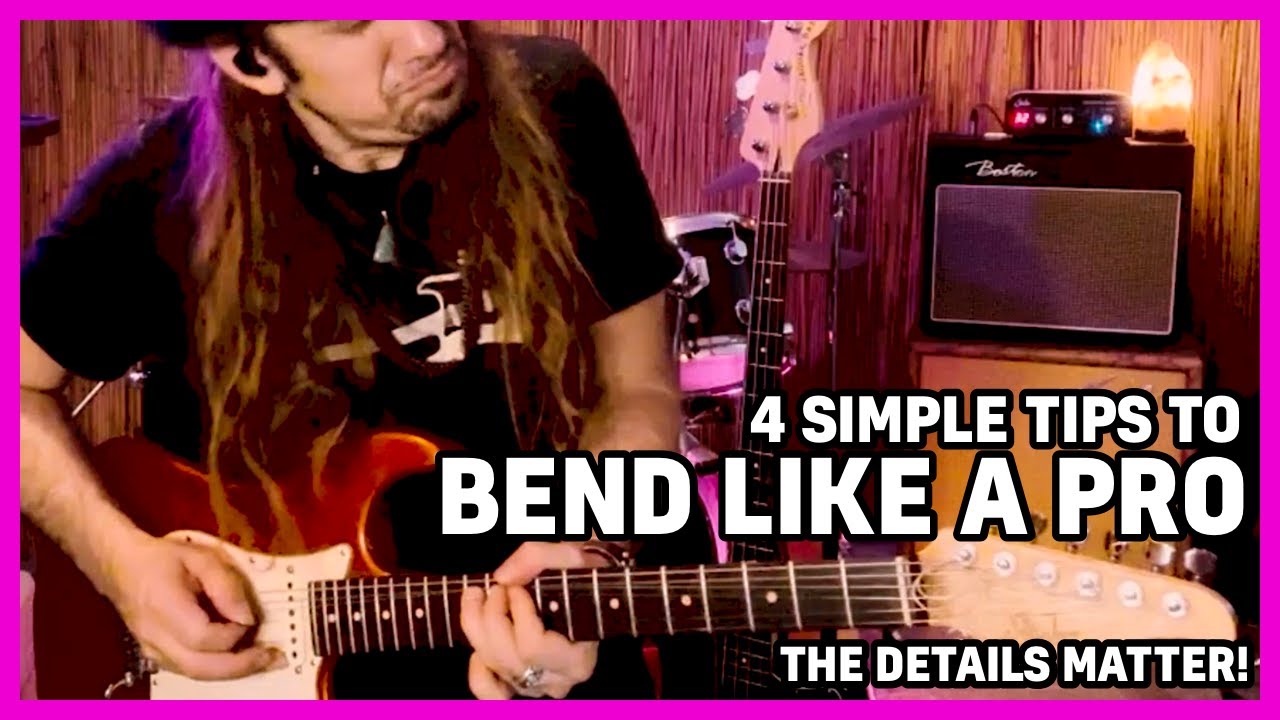
Electric Guitar Phrasing Tricks - Bending Strings
Electric Guitar Phrasing Tricks: Mastering String Bending
Bending strings is often overlooked by guitarists chasing after flashy techniques. But if you master this “unsexy” skill, you can transform your phrasing and sound more professional, soulful, and expressive. In today’s lesson, I’ll walk you through the art of string bending and show you how to make your playing stand out. Stick around, and let’s unlock your guitar’s potential!
Why String Bending Deserves Your Focus
Let’s be honest: bending strings doesn’t sound as exciting as shredding scales or learning two-hand tapping. But here’s the truth: bending is one of the most important skills for guitarists who want to focus on phrasing and melody. There’s nothing more impressive than a simple blues lick played with precise, in-tune bends.
As an adult guitarist, you might have spent a lot of time obsessing over what notes to play. But equally important is how you play them. A great bending technique can breathe life into your solos, allowing you to convey emotion and connect with your audience.
But bending isn’t just about pulling on a string. It’s about control, precision, and technique. Let’s break it down into actionable steps to improve your bending game.
Step 1: Train Your Ear for Perfect Pitch
One of the most common mistakes in bending is relying solely on muscle memory. Every guitar is different—your short-scale guitar, Strat with heavier strings, or floating tremolo system will all require different amounts of pressure to achieve the perfect pitch. That’s why your ear is your most important tool.
Here’s how to practice:
- Play the target note on another string and match it with your bend. For example, bend the 7th fret of the G string up to match the pitch of the 8th fret on the B string.
- Use a tuner to check your accuracy as you bend. This helps you develop the muscle memory and ear training needed to lock in the pitch.
- Focus on consistency. Every bend should hit the pitch perfectly, whether it’s a half-step or whole-step bend.
Remember, great bending is about feeling and hearing the note, not just “pushing” strings blindly.
Step 2: Use the Right Mechanics
Good bending technique starts with proper mechanics. Let’s break it down:
- Keep your wrist straight: Your wrist should remain stable and straight while bending. A bent wrist limits your strength and control. Think about grabbing something or knocking on a door—your wrist is strongest when it’s straight.
- Bend with your wrist, not your fingers: The motion of a bend should come from the wrist, not your fingers pushing the string. Imagine twisting the throttle of a motorcycle—that’s the same motion you want while bending.
- Use the ring finger: For most bends, your ring finger is the strongest option. Support it with your middle and index fingers for extra strength and control. Avoid relying on your pinky finger; it’s weaker and less stable, making it harder to achieve clean and controlled bends.
By focusing on wrist motion and using your stronger fingers, you'll develop a reliable bending technique that works across different guitars and string gauges.
Step 3: Avoid Downward Bends on the G String
Here’s a pro tip that can make a big difference: avoid bending downward on the G string. While it might feel natural at first, this habit can lead to inconsistent technique and limit your phrasing options. Stick to bending high strings upward and low strings downward for a streamlined and professional bending approach.
Consistency is key. When you develop a reliable bending direction, you eliminate unnecessary variables that can throw off your playing. This habit also makes it easier to transition between different strings and positions while keeping your phrasing smooth and fluid.
Take Your String Bending to the Next Level
Mastering string bending is about more than just hitting the right note—it’s about adding emotion, dynamics, and character to your playing. By focusing on ear training, proper mechanics, and refining your technique, you’ll be able to transform even the simplest licks into something truly special.
Remember, the greats like Richie Blackmore, Carlos Santana, and Mark Knopfler all mastered this fundamental skill. It’s your turn to join their ranks and elevate your guitar playing.
Ready to finally break through your plateau? Apply for a free strategy session and let's map out your path to guitar freedom.