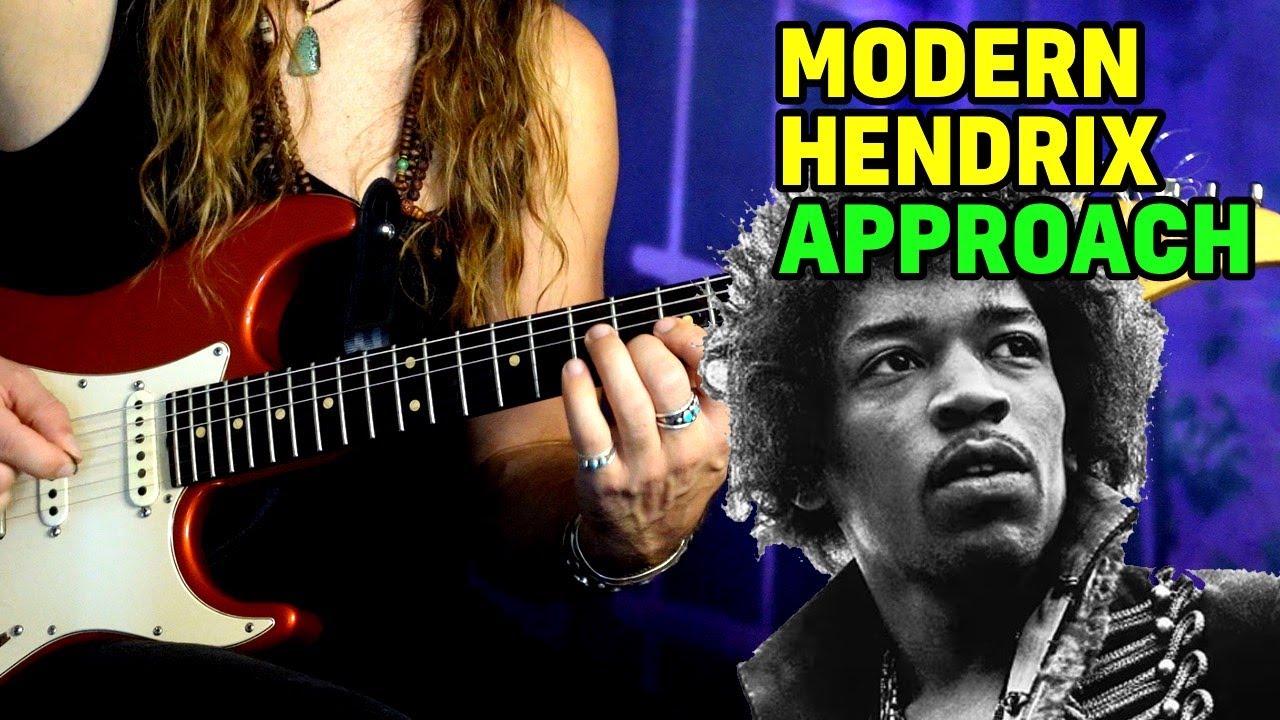
How This Hendrix Chord Trick Makes Guitar Easy!
How This Hendrix Chord Trick Makes Guitar Easy: Master the Cordal Style in Minor Keys
If you've been stuck playing the same old pentatonic licks up and down the fretboard, you're not alone. Most guitar players hit a wall where standard scale exercises stop delivering results, and progress feels impossible. But what if there was a proven technique that legendary guitarists like Jimi Hendrix used to create memorable, expressive solos without needing to learn tons of new theory?
The Hendrix cordal style is exactly that—a game-changing approach that transforms your lead guitar playing by using the same five pentatonic notes you already know, just organized differently. The real magic happens when you learn how to apply this technique across different harmonic contexts, especially in minor and modal settings where most guitarists feel lost.
In this lesson, Ulrich Ellison reveals something that could completely revolutionize the way you improvise: how to use Hendrix-style cordal vocabulary over Dorian minor contexts, giving you access to deeper, richer textures and sounds that instantly elevate your playing.
The Core Principle: Major Chords in Minor Settings
Here's where most guitar teachers get it wrong. They teach you modes and scales in isolation, expecting you to somehow magically connect them to actual music. But real improvisation doesn't work that way.
The breakthrough principle that Ulrich demonstrates is elegantly simple: over a D minor chord, you can play an F major cordal style lick and then resolve it back to the D note. This single concept opens up entirely new harmonic possibilities because you're no longer thinking in terms of scales—you're thinking in terms of chord qualities and how they function within a harmonic context.
The beauty of this approach is that it doesn't require learning new notes. You're using the same pentatonic vocabulary, just organizing it around specific chord tones and resolutions. This makes it immediately implementable, even if you're still building your foundational knowledge.
When you combine this cordal thinking with traditional pentatonic licks, you start creating rich textures and sophisticated phrasing that rivals what professional session musicians use. You move from sounding like someone doing exercises to sounding like an actual musician making intentional musical choices.
Understanding Triad Pairs: The Secret to Modal Improvisation
The next level of sophistication involves understanding triad pairs—a concept that transforms how you think about modal improvisation. In a Dorian context, you have access to multiple major triads that all work harmonically.
For D Dorian specifically, you can use both F major and G major cordal licks. Why? Because Dorian mode contains both of these triadic qualities. This isn't random—it's deeply rooted in harmonic theory that major jazz musicians and progressive rock legends have understood for decades.
The cordal style is fundamentally an embellishment method for major triads. When you embellish both the F major and G major triads, you get an authentic Dorian sound. This means you can move fluidly between different chord qualities while staying perfectly in context, creating solo passages with genuine harmonic depth.
This is what separates confident, competent lead guitarists from those who are just running scales. You're no longer thinking "what scale am I in?" You're thinking "what triads are available, and how can I embellish them musically?" It's a fundamental shift in perspective that changes everything.
Layering Techniques: Connecting Your Vocabulary Fluidly
One critical insight that Ulrich emphasizes is never using any single technique in isolation. Instead, the most expressive players constantly layer different approaches, moving fluidly from one technique to the next. This creates the sophisticated, connected phrasing you hear in truly great soloists.
When you're improvising, you're constantly shifting between pentatonic patterns, cordal embellishments, major triad licks, and resolution notes. The trick is making these transitions smooth and musical rather than obvious or jarring. That fluidity is what separates a interesting solo from a transcendent one.
The practical application is that you develop what Ulrich calls "lick archetypes"—foundational phrases you can combine and recombine in different ways. You master a few reliable patterns, then apply them across different harmonic contexts (Dorian, Aeolian, mixolydian, and beyond). Suddenly, your improvisational vocabulary explodes exponentially without actually learning tons of new material.
This approach works across all seven modes and in all 12 keys. Once you understand the principle, you can immediately transfer it to any musical situation. That's the power of learning concepts instead of memorizing patterns.
Ready to finally break free from the pentatonic prison and start playing with genuine harmonic sophistication? Apply for a free strategy session and discover exactly what foundations you need to build to confidently improvise like the musicians you admire. Your breakthrough is waiting.