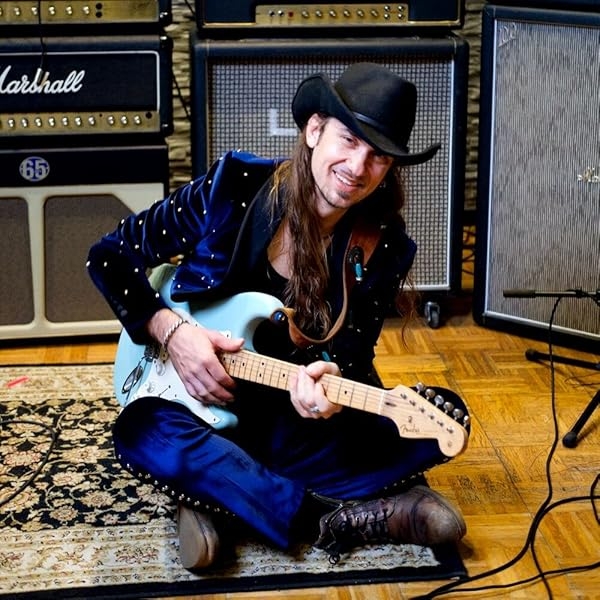
I brought a low-budget guitar to a symphonic rockshow with 40 musicians
I Brought a Low-Budget Guitar to a Symphonic Rock Show with 40 Musicians
When you're a touring guitarist, you face challenges most bedroom players never encounter. Traveling between countries, learning songs with minimal prep time, and performing in front of massive orchestral ensembles with high production standards—these situations separate the professionals from the hobbyists. Recently, I had the opportunity to do exactly that when I was invited to perform at a symphonic rock show in Brno, Czech Republic, featuring over 40 musicians. But here's the twist: I decided to bring my budget-friendly Inspire guitar to this high-stakes performance.
The journey started after returning from Egypt, where I had just finished an incredible desert jam session with local Bedouins. Now, I was heading to Czech Republic to perform at my friend Voytech's city release show—a production he had booked at the stunning Sono Music Hall. The venue was nothing short of gorgeous, with enough backstage area to rival the chaos depicted in the classic mockumentary "Spinal Tap." But before I could get comfortable, I had to face the reality of what I'd committed to.
The Reality of Large-Scale Productions: Logistics and Preparation
One of the biggest takeaways from this experience is understanding the sheer magnitude of logistics required to pull off a show of this caliber. With 40 musicians on stage, every instrument needs to be properly miked up, every musician needs to be soundchecked, and every score needs to be printed and distributed. Add in itineraries, scheduling, catering, and accommodations for out-of-town band members, and you've got a production manager's nightmare.
When I arrived at the venue, my friend Voytech was barely able to grab a few words before the show—he was completely consumed by the endless details required to make everything run smoothly. This is a critical lesson for any guitarist aspiring to work at professional levels: understand that you're part of a much larger machine. Your job isn't just to play well; it's to be reliable, prepared, and adaptable to whatever circumstances arise.
The soundcheck was already in full swing when I arrived. I could see the full string section, hear the orchestral arrangements, and get a sense of what I was about to be part of. The purple Inspire guitar I'd brought actually matched the theme of the show perfectly—a small detail, but it mattered in the professional context.
Managing Technical Risk: What Can Go Wrong and How to Prepare
Here's the uncomfortable truth: when you're performing at a high-level production with minimal prep time, things can go catastrophically wrong. I hadn't changed the strings on my Inspire guitar since receiving it, and this instrument had already been through a desert jam session in Egypt. The strings were worn, potentially compromised. The borrowed amplifier could blow a tube at any moment. Any one of the 40 musicians on stage could accidentally step on a cable during my solo, yanking it out of the amp mid-performance. And here's the kicker—I had only learned three songs, and learning them is an understatement.
This is where professionalism truly matters. A big part of being a pro guitarist isn't just about technical ability—it's about identifying potential failure points and creating contingency plans. I made the decision to focus on what I could control: showing up early, familiarizing myself with the stage setup, interacting with the other musicians to build rapport, and mentally preparing for the performance itself.
The Performance: Proving the Budget Guitar's Worth
When showtime arrived, everything had to come together. Despite the minimal preparation, the light-budget Inspire guitar held up remarkably well. I didn't break a single string. The borrowed amp performed flawlessly. I made it through all the songs without significant mistakes, and more importantly, I was able to interact authentically with the other musicians on stage. We connected, we made new friends, and we created something genuinely musical together.
The lesson here extends beyond just "the guitar worked fine." What really mattered was that I approached this high-pressure situation with the mindset of a professional. I understood the stakes, I prepared mentally for what could go wrong, and I stayed focused on delivering value to the production and the audience.
If you're serious about taking your guitar playing to the next level—whether that means performing with orchestras, touring, or handling complex musical situations—you need more than just technical skills. You need a system for preparation, risk management, and continuous improvement. Ready to finally break through your plateau? Apply for a free strategy session and let's map out your path to guitar freedom.