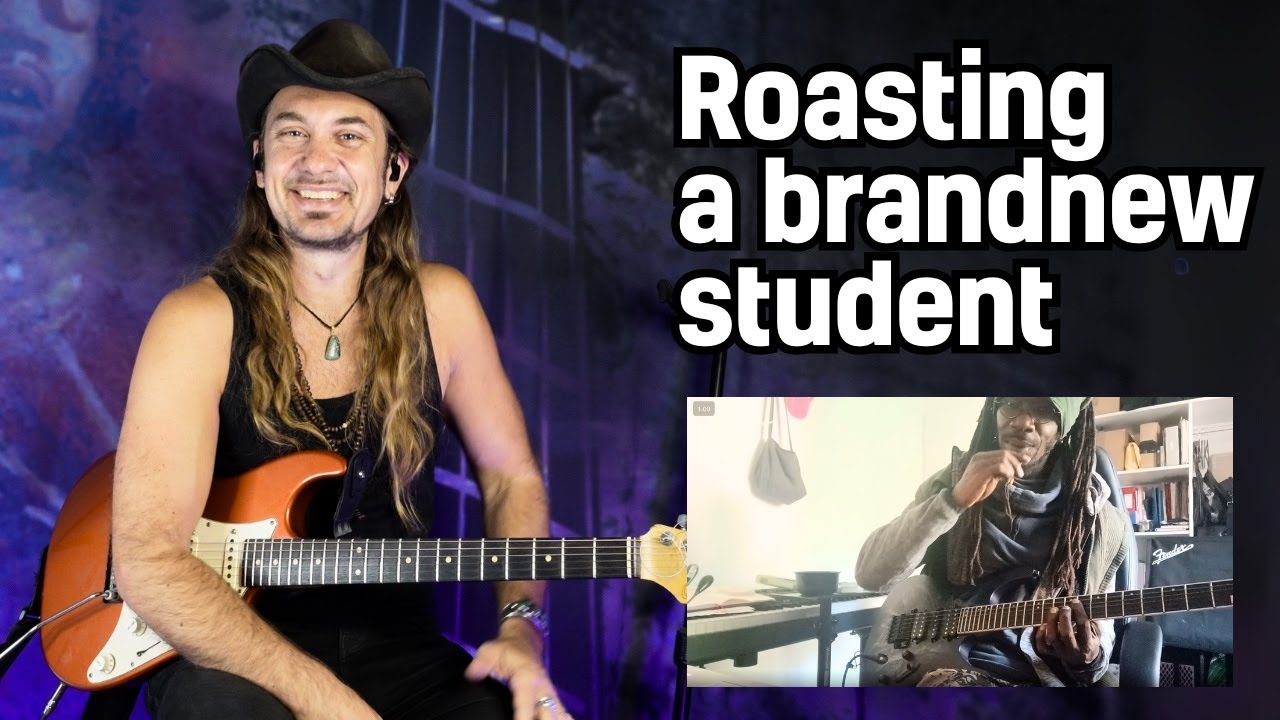
I roasted a stranger's guitar playing on camera (here's what happened)
I Roasted a Stranger's Guitar Playing on Camera: Here’s What Happened
What happens when you get personalized feedback on your guitar playing from a pro? That’s exactly what Jean Mark from France discovered when he won a private Zoom lesson with me as part of my recent backing track challenge. In this blog post, I’ll share the key takeaways from our session, including tips to improve your improvisation, phrasing, and overall guitar tone. Whether you're an intermediate or advanced guitarist, these insights might just help you break through your creative plateau!
1. Mastering Rhythm: Balancing Short and Long Notes
One of the first things I noticed in Jean Mark’s playing was his tendency to rely on short, staccato notes. While these can add a rhythmic punch and energy to your solos, they can also feel repetitive if not contrasted with longer, sustained notes. Long notes bring emotional power and dynamic contrast to your improvisation.
Here’s a simple exercise to practice this:
- Play a short phrase of quick, punchy notes over a backing track.
- Follow it up with a long, expressive note that sustains for at least 2-3 beats.
- Experiment with vibrato and bending to give your long notes extra soul.
By incorporating both short and long notes, you’ll add depth and variety to your solos, making them more engaging for your listeners.
2. Avoiding Unwanted Notes: Building Interval Awareness
During the lesson, Jean Mark hit a couple of notes that clashed with the backing track’s key. It turned out that his fingers were defaulting to a familiar scale shape instead of truly listening to the intervals. This is a common issue for guitarists who rely on muscle memory rather than ear training.
To strengthen your connection to intervals, try this exercise:
- Pick a root note and play a drone in the background (use a looper pedal or a YouTube drone track).
- Play each interval (minor 2nd, major 2nd, etc.) on the same string, listening to how it feels and sounds against the drone.
- Focus on the emotional "personality" of each interval. For instance, a minor 3rd might feel melancholy, while a major 3rd sounds bright and happy.
When you truly connect with the sound of each interval, you’ll avoid hitting those “unwanted dissonances” and instead create melodies that feel intentional and musical.
3. Breaking Free from Scale Shapes: Adding Wide Intervals
One of the highlights of Jean Mark’s playing was his use of wide intervals, which added a refreshing, musical quality to his solos. Many guitarists get stuck in the habit of running up and down scale shapes without incorporating leaps between notes. This can make solos sound predictable and robotic.
Here’s how to practice using wide intervals:
- Instead of playing consecutive notes in a scale, skip one or two notes to create larger leaps.
- For example, in a minor pentatonic scale, try jumping from the root note to the 5th, then back to the minor 3rd.
- Experiment with combining wide intervals and smaller steps for a more dynamic, melodic sound.
Not only does this approach make your solos more interesting, but it also forces you to think creatively about phrasing and melody.
By analyzing and tweaking these aspects of Jean Mark’s playing, we were able to take his improvisation to the next level. These same strategies can work wonders for your guitar playing too!
Ready to Take Your Guitar Playing to the Next Level?
If you found these tips helpful, imagine what a personalized, one-on-one lesson could do for your playing. Whether you're struggling with improvisation, technique, or tone, I’m here to help you unlock your full potential. Don’t wait—Apply for a free strategy session and let’s map out your path to guitar freedom. With limited slots available, now’s the perfect time to take that next step toward becoming the guitarist you’ve always wanted to be!