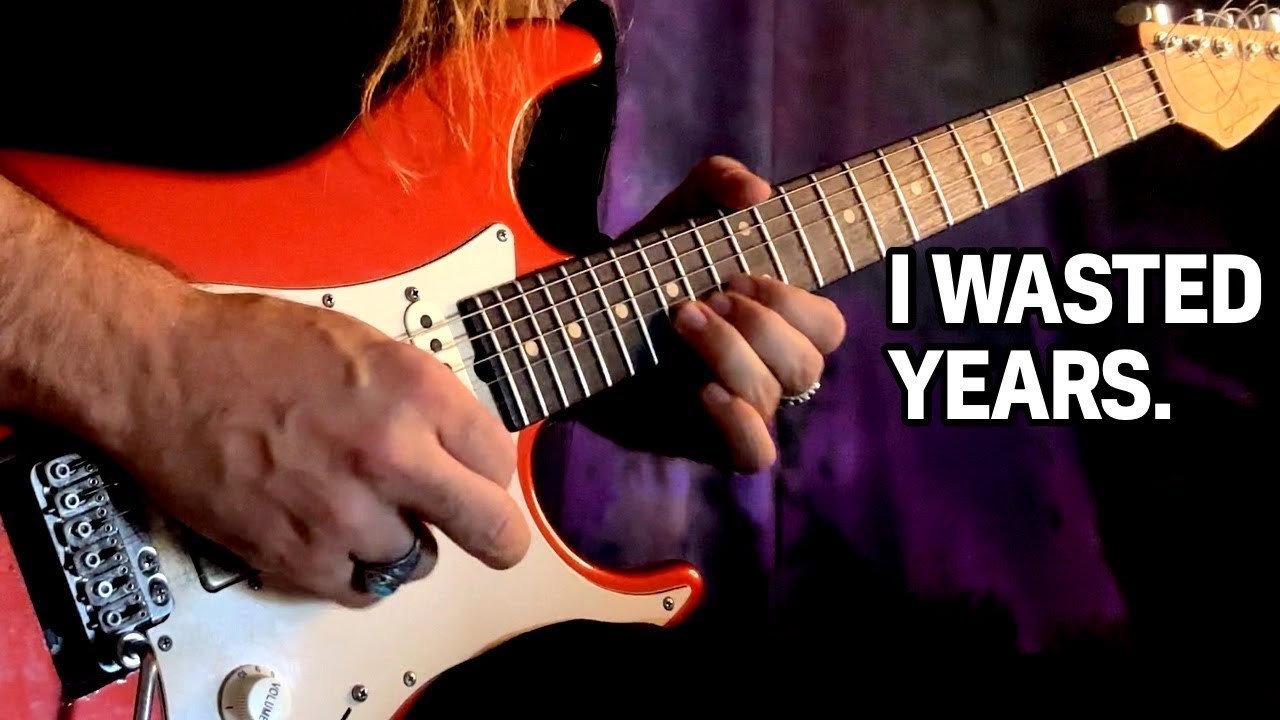
The 3 Exercises That 10X’D My Guitar Progress
The 3 Exercises That 10X'd My Guitar Progress
After 25+ years as a professional guitarist, I've learned that the secret to rapid improvement isn't about finding the most complicated exercises or flashy techniques. It's about consistency, intentional practice, and understanding what you're actually doing when your fingers hit the strings. In this guide, I'm sharing the three exercises that transformed my playing and have helped hundreds of my students at Total Guitar Transformation break through their plateaus and finally achieve the progress they've been chasing.
Exercise 1: The One String Approach – Break Free From Box Patterns
When I first discovered the one string approach in Mick Goodrich's work, I'll admit I was almost offended by how simple it sounded. But here's the thing: simplicity doesn't mean ineffective. In fact, this single exercise became the missing piece in my playing that I didn't even know I was looking for.
Here's why this works: most of us learn guitar through patterns and boxes from day one. We visualize the fretboard vertically, moving up and down within these predetermined shapes. The one string approach completely dismantles that habit and forces your brain to work differently.
When you improvise on a single string, the physical distance your finger travels becomes the interval you're playing. This forces you to develop ear training in a way that box patterns never will. You can't rely on muscle memory or visual patterns anymore—you have to actually listen and respond to what the backing track is telling you.
Start with just 5-10 minutes daily on one string, using a backing track. Focus on phrasing, string bending, vibrato, and slides to make your solo musical, not mechanical. Once you're comfortable, move to each of the remaining strings individually. Eventually, work through this exercise in all 12 keys. The transformation in your fretboard awareness will be dramatic.
Exercise 2: The Legato Sequence – Unlock Fluid, Expressive Playing
In my teenage years, I was obsessed with players like Joe Satriani, but I couldn't figure out how to achieve that fluid, seamless sound. I was practicing alternate picking religiously, but I kept hitting a wall. I wasn't sure if it was a speed issue, accuracy problem, or simply lack of talent for the technique.
Then I discovered a powerful legato sequence that opened up an entirely new dimension in my playing. This sequence uses a specific finger pattern—4-1-3-4-3-1 if you number your fingers 1-4—performed on a single string. Make small, controlled movements, and the key is to shift this sequence up and down the scale.
This isn't just about technical drilling, though that's valuable. The real power comes when you learn to integrate this legato work into actual musical phrases. Combine it with blues bends, slides, and your existing techniques. You'll discover that this sequence strengthens your overall legato chops and makes other legato passages dramatically easier to execute.
Work through the sequence in one key over a backing track, then expand it across the fretboard using three-notes-per-string shapes. Practice for consistency, then start weaving it into your improvisations alongside traditional blues vocabulary. Watch how quickly your phrasing becomes smoother and more expressive.
Exercise 3: The Game-Changer – Building Real Musical Independence
While the transcript hints at a third revolutionary exercise, the complete details weren't fully captured in this particular section. However, what Ulrich emphasizes is that this third approach fundamentally changed how he views guitar playing itself—not just technically, but philosophically.
The common thread through all three exercises is this: they're designed to break you free from the limitations of traditional box-pattern thinking. They force your ear to develop independently from your eyes. They make you a more creative, responsive player who can actually communicate musically rather than mechanically cycling through patterns.
The Real Key: Consistency Over Complexity
Notice that none of these exercises requires advanced technique or complex theory. What they require is commitment. Five to ten minutes daily with focused intention will transform your playing far more effectively than sporadic hours of unfocused practice.
The guitarists who make real breakthroughs aren't necessarily the most talented—they're the ones who consistently show up and work with intention. They understand that the exercise itself is just the vehicle; their focused attention and honest self-assessment are what drive actual progress.
Ready to finally break through your plateau and take your lead guitar playing to the next level? Apply for a free strategy session and let's map out your personalized path to guitar freedom. I've helped hundreds of serious guitarists transform their playing—let's see what's possible for you.