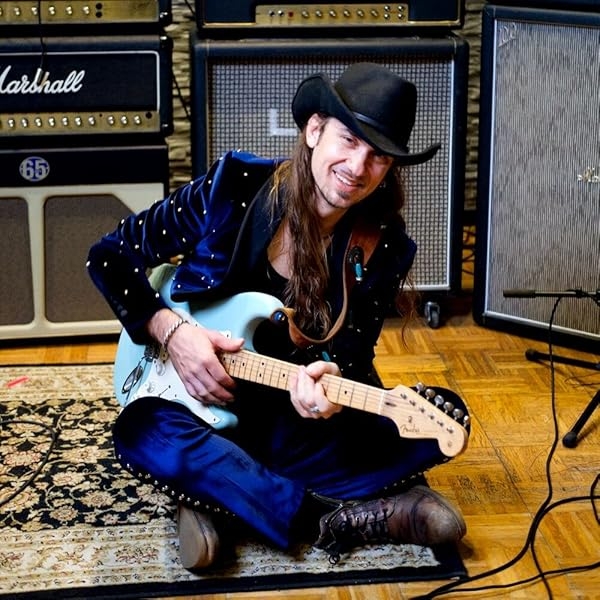
The Power of Phrygian
The Power of Phrygian: Unlock an Exotic Guitar Color Beyond Theory
If you've spent any time in guitar forums or watching YouTube tutorials, you've probably heard modes discussed endlessly. And at the end of the day, most guitarists walk away confused about how to actually use these sounds in their playing. Today, we're breaking that cycle with a fresh perspective on one of the most misunderstood modes: the Phrygian scale.
The Phrygian mode gets a bad rap. Most Western guitarists associate it exclusively with dark, melodic metal vibes. But this perspective is dangerously limiting. Here's what most guitar teachers won't tell you: if you spend time in countries like Turkey or Egypt, the Phrygian mode isn't exotic at all—it's the main sound you hear on the radio, in the streets, and woven throughout the culture's musical fabric. It's not a dark color. It's home.
This is the key insight that transforms how you'll approach Phrygian from this moment forward. It's not just a mode derivative of the major scale. It's a legitimate, rich musical universe with thousands of years of history behind it.
Understanding Phrygian Mode: The Note-by-Note Breakdown
Let's strip away the theory clutter and build Phrygian from the ground up. Here's what makes E Phrygian unique compared to other scales:
The Notes of E Phrygian:
- Root (E)
- Flat 2 (F)
- Flat 3 (G)
- Perfect 4 (A)
- Perfect 5 (B)
- Flat 6 (C)
- Flat 7 (D)
That flat 2 interval right after the root? That's the signature Phrygian sound. It's exotic, it's Spanish, it's Middle Eastern. It's the color that makes people lean in and ask, "What scale is that?"
There's also a variation worth exploring: Phrygian Dominant. This uses a major 3rd instead of the flat 3, which creates a completely different vibe—still exotic, but brighter, more energetic.
Here's the critical point: forget about thinking of Phrygian as "the third mode of C major." That mental framework is suffocating your creativity. Emancipate it completely. Phrygian is its own universe, its own color palette, its own emotional landscape.
Start Playing Phrygian With a Drone—Not Scale Shapes
The biggest mistake intermediate guitarists make is approaching Phrygian through scale patterns and shapes. This academic approach kills the musicality before you even start.
Here's what you should do instead:
Take a single string—preferably the high E string—and grab a drone app (or ask a practice partner to hold the root note). Now, forget everything you know about positions and patterns. Just play. Experiment with slides, bends, and phrasing. Move around the string organically. Listen. Feel. Respond to what the Phrygian color is telling you emotionally.
This is how musicians in Turkey, Egypt, and throughout the Middle East learned this mode for centuries. Not through books or YouTube lessons, but through immersion and imitation. They heard it, felt it, and played it.
Once you've spent real time exploring Phrygian this way—at least a few weeks of regular practice—then start thinking about chords and applications.
Phrygian in Musical Context: From Turkish Folk to Modern Metal
The beauty of Phrygian is its versatility. It's not locked into one genre or emotional palette. You can hear it in:
- Turkish folk music – Where it's the foundation of traditional songs
- Spanish flamenco – Creating passion and drama
- Progressive metal – Artists like Joe Satriani have explored Phrygian deeply, particularly in his album The Extremist
- Jazz and fusion – Adding color and tension to improvisation
- Modern composition – Film scores, ambient music, and experimental genres
The fastest way to develop a real feel for Phrygian? Put on recordings of musicians who live and breathe this mode. Listen to traditional Turkish musicians. Try jamming along with them, even if you're "butchering" it at first. This active listening combined with attempting to play along is how your ear develops real familiarity with the sound.
This approach transforms Phrygian from an abstract theoretical concept into a living, breathing part of your musical vocabulary.
Ready to move beyond intermediate plateau guitar playing and start expressing yourself with real freedom and color? The modes—including Phrygian—are just one piece of the puzzle. At Total Guitar Transformation Academy, we help guitarists like you break through that stuck-in-the-middle feeling and develop into fluid improvisers who can play what they hear and feel. Ready to finally break through your plateau? Apply for a free strategy session and let's map out your path to guitar freedom.