The Ultimate Guide to Structured Lead Guitar Practice for Adults
What if the reason your solos feel like mechanical exercises isn't a lack of talent, but a lack of intention? If you've spent years trapped in the rigid walls of pentatonic box shapes or felt your creativity stifled by hand fatigue, you aren't alone. Many adult learners hit a ceiling where their playing feels more like a technical chore than a form of personal expression. Embracing a structured lead guitar practice routine is the bridge between hitting notes and actually making music. It's the vital difference between reciting a dry list and telling a captivating story that resonates with every listener.
You deserve to feel a deep, physical connection to your instrument that transcends simple drills. This guide reveals a transformative 3-pillar framework designed to break through frustrating plateaus and develop a soulful, expressive lead guitar voice in just 30 minutes a day. We will explore how to navigate the fretboard with total freedom, dissolve the mechanical sound of your exercises, and finally unlock the musicality you've been chasing. It's time to stop surviving your practice sessions and start thriving within them as a true creator.
Key Takeaways
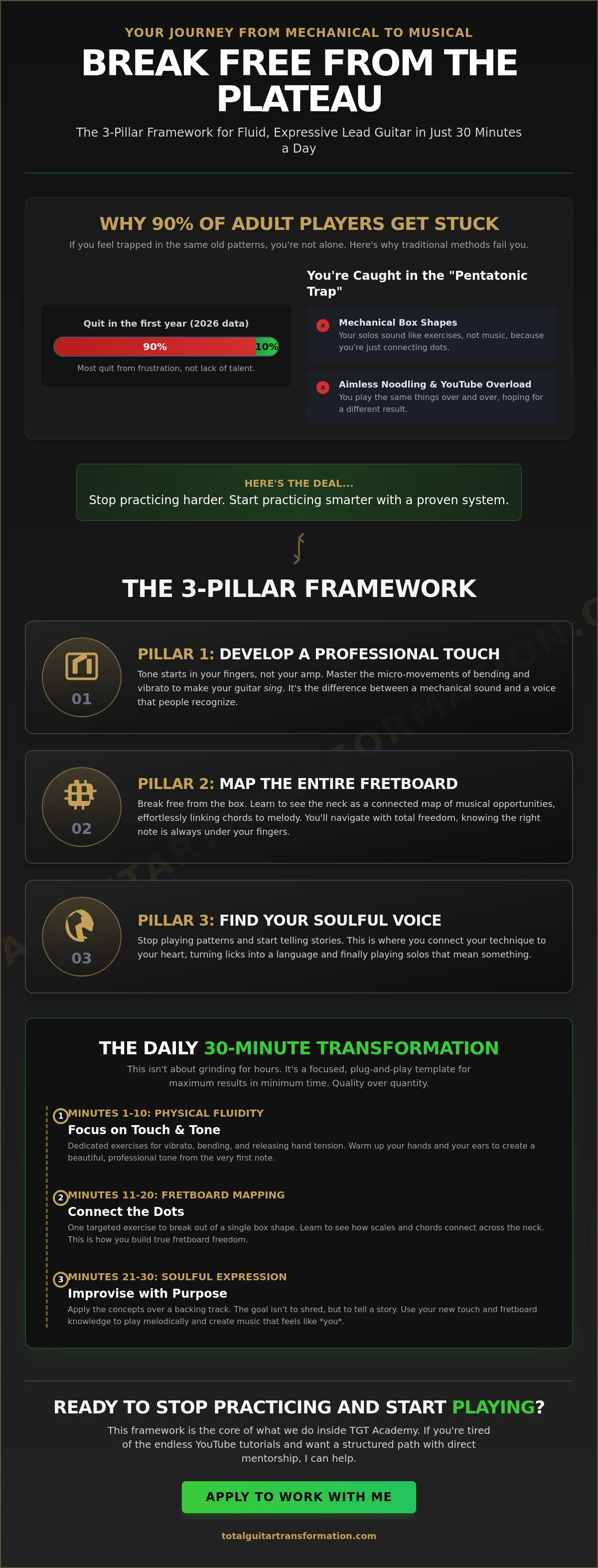
- Identify the fatal flaws in traditional routines and learn how to escape the "Pentatonic Trap" that keeps your solos sounding repetitive.
- Master a holistic 3-pillar framework that balances physical touch with mental fretboard clarity for a truly expressive lead voice.
- Adopt a Hendrix-inspired "chord-lead" connection to navigate the entire neck with freedom; this moves you far beyond restrictive box shapes.
- Execute a high-impact, 30-minute structured lead guitar practice template designed specifically for the busy adult schedule.
- Break the cycle of information overload by understanding how mentorship and community provide the clarity that YouTube tutorials lack.
Table of Contents
-
Why Traditional Lead Guitar Practice Routines Fail the Adult Learner
-
The 30-Minute Daily Transformation: A Template for Busy Adults
Why Traditional Lead Guitar Practice Routines Fail the Adult Learner
If you've ever sat down with your guitar only to find yourself mindlessly running the same minor pentatonic scale for the thousandth time, you've felt the sting of stagnation. For many, the dream of playing a soulful solo is buried under a pile of uninspired "to-do" lists. Traditional methods often treat learning as a clinical series of drills, but for the experienced adult, this approach lacks the emotional heat required for true growth. Real progress isn't found in a chore list; it's found in a structured lead guitar practice that acts as a holistic system, connecting your physical touch to your inner musical ear.
The most common hurdle is what we call the "Pentatonic Trap." While memorizing box shapes provides a temporary sense of security, it eventually becomes a mental cage. You find yourself playing patterns rather than melodies, moving your fingers because the shape demands it, not because your heart feels the next note. This mechanical approach stunts your musical growth because it ignores the relationship between the notes and the underlying harmony. To break free, you must stop viewing the fretboard as a series of disconnected grids and start seeing it as a landscape of expressive potential.
Noodling is the silent thief of your progress. It feels like playing, but it's actually just a repetitive loop of your most comfortable habits. When you noodle, you aren't challenging your brain or your hands; you're simply confirming what you already know. Replacing these aimless sessions with intentionality is the first step toward a professional sound. By choosing a specific focus for every minute you spend with the instrument, you transform your time from a passive hobby into an active pursuit of mastery.
The Myth of the 10,000 Hour Rule for Hobbyists
Adult learners often feel they've started too late to achieve excellence, but the quality of your focus is far more important than the quantity of your hours. You don't need decades of grueling labor to sound professional if you apply the principles of effective practice to your daily routine. Deep work on the fretboard means engaging with the instrument in a state of total presence, where every vibrato and every bend is executed with absolute awareness. Repetitive scale drills offer diminishing returns; after the first few minutes, your brain disengages and the learning stops. High-intensity, focused sessions allow you to achieve in thirty minutes what others struggle to find in three hours.
Overcoming Physical Barriers in Older Hands
If you're playing in the 45 to 70 plus age range, your physical needs are different from a teenager's. Speed shouldn't be a product of raw, tension-filled effort, which only leads to fatigue and potential injury. Instead, focus on fluidity and the economy of motion. Developing a light, purposeful touch allows you to play with more authority while exerting less energy. Ergonomic positioning is vital to prevent stiffness; the way you hold your pick and the angle of your wrist can be the difference between a twenty-minute limit and an hour of joyful playing. For a deeper look at adapting your physical approach, explore our guide on Guitar Technique for Older Hands to ensure your journey remains comfortable and sustainable.
The 3-Pillar Framework for Meaningful Lead Guitar Progress
If you've ever felt like your hands and your heart are speaking different languages, you're likely experiencing a disconnect between your physical skills and your musical vision. True mastery isn't a result of luck; it's the product of a balanced ecosystem. A structured lead guitar practice moves beyond the repetitive grind of scales by focusing on three essential pillars: Physical Fluidity, Fretboard Mapping, and Soulful Expression. When these elements work in harmony, you stop playing "at" the guitar and start playing through it. Each pillar supports the other. Without the physical touch, your musical ideas can't breathe. Without a map of the neck, your fingers have no direction. Without soul, your playing remains a technical exercise rather than a human connection.
This framework is designed to turn your limited practice time into a period of intense, creative growth. Instead of feeling overwhelmed by the vastness of music theory, you'll focus on the specific mechanics and mental models that professional players use to command the stage. If you're ready to see how these pillars come together in a real-world routine, our 12-Month Guitar Transformation Academy provides the exact blueprint for this journey.
Pillar 1: Developing a Professional Touch
The difference between an amateur and a professional often lies in the micro-movements of the fretting hand. It isn't about how fast you can move, but how much control you exert over every vibration of the string. Tone begins in your fingertips, not your amplifier. By refining your vibrato and mastering the subtle art of string bending, you define your personal voice. A great vibrato acts like a singer's breath; it gives a note life, heat, and sustain. Focusing on the economy of motion ensures that your hands remain relaxed, allowing for a fluid movement that feels effortless even during complex passages. You'll find that as your touch lightens, your tone becomes thicker and more authoritative.
Pillar 2 & 3: Mapping the Soul to the Fretboard
Moving across the neck should feel like walking through a familiar home, not wandering in a dark forest. To achieve this, you must shift from thinking in rigid scale shapes to hearing in melodies. This transition happens through Interval Awareness. When you understand the emotional "flavor" of each note relative to the chord behind it, you gain the ability to navigate the neck intuitively. You'll start targeting chord tones that anchor your solos, giving them a sense of purpose and resolution. This mental clarity allows you to employ call and response phrasing. By "asking a question" with one phrase and "answering" it with the next, you tell a musical story that captures the listener's attention. This Hendrix-inspired approach blends rhythm and lead into a single, soulful conversation that transcends the "mechanical" sound of standard drills.
Breaking the "Box Shape" Habit: A Hendrix-Inspired Approach
Jimi Hendrix didn't just play the guitar; he manipulated the air around it. His secret wasn't a mastery of complex, mathematical scales, but a deep, intuitive connection to the shapes of the chords themselves. If you've spent years trapped in the "box," you know how frustrating it is to feel like you're just typing on a keyboard rather than singing. A truly structured lead guitar practice shifts your focus from running patterns to targeting the heartbeat of the song. This psychological pivot allows you to stop "playing a scale" and start "playing the music." It's a transformative shift that moves you away from the mechanical and toward the magical.
By visualizing the fretboard through the lens of the underlying harmony, you gain the freedom to move vertically and horizontally without fear. You aren't just moving your fingers; you're guiding the listener through the emotional landscape of the track. This approach turns every solo into a conversation. It's the difference between reciting a list of ingredients and serving a gourmet meal. When you stop worrying about which "box" you're in, you start hearing the melodies that have been hiding in plain sight all along.
The Power of Chord-Based Soloing
The most effective way to break your box-shape habit is to map the CAGED system directly to your lead lines. You don't need a degree in music theory to do this. Simply look at the chord shape under your fingers and identify the "sweet notes," which are the specific intervals that give the chord its color. When you land on a major third exactly as the chord changes, the effect is immediate and professional. It provides a sense of resolution that scale-running simply cannot match. If you're ready to stop wandering aimlessly, our guide on Breaking Out of Pentatonic Boxes offers a clear path to this visual clarity.
Rhythmic Freedom in Lead Playing
Many adult learners struggle with "quarter note boredom," where every phrase starts on the first beat and ends on the fourth. To capture that elusive Hendrix feel, you must embrace syncopation and, more importantly, space. The notes you don't play are often more powerful than the ones you do. Think of your lead lines like a human voice. A singer has to breathe; your solos should too. By using vocal-like phrasing, you increase the emotional impact of every note you choose. Practice leaving gaps. Let the rhythm section breathe. When you finally strike that target note after a moment of silence, it will carry a weight that a thousand fast notes never could. This intentional use of silence is what separates the masters from the students.
The 30-Minute Daily Transformation: A Template for Busy Adults
Time is the adult learner's most precious asset. To move the needle, you don't need hours of aimless playing; you need a system that respects your schedule. A structured lead guitar practice session of just thirty minutes can yield more growth than a three-hour marathon of directionless noodling. By dividing your time into deliberate phases, you ensure that every aspect of your playing, from physical touch to creative expression, receives the attention it deserves. This template is your roadmap to a professional sound, designed to fit into the cracks of a busy life while building a legacy of musical skill.
For those who prefer a more measured pace, this routine is easily adaptable. If you can only commit to three sessions a week, you can shift toward a "Two-Year Graduation" plan. The key isn't the speed of the journey, but the consistency of the steps. If you want to fast-track these results with a community of like-minded players, join the TGT Guitar Coach Club for guided self-study that keeps you on track.
-
Minute 1-5: The Fluidity Warm-up. Focus entirely on the quality of your touch. Don't worry about speed. Instead, feel the string under your fingertips and ensure every note rings out with a vibrant, clean tone.
-
Minute 6-15: Fretboard Mapping. Practice targeting new zones on the neck using the chord-tone connections we discussed. Visualize the "target notes" within a specific backing track.
-
Minute 16-25: The Soul Session. This is your time to improvise. Set specific phrasing constraints, such as only using three notes or playing only on the top two strings, to force your brain to find new melodic paths.
-
Minute 26-30: Reflection and Review. Put the guitar down. Think about what felt easy and where you felt tension. This mental review is the secret to locking in your progress for the next day.
Phase 1: Mechanical Ease and Connection
In the first few minutes, your goal is to sync the left and right hands without a shred of tension. Use a metronome, but use it to find the "groove" rather than just chasing a higher BPM. When you practice with a pulse, you're training your internal clock. The rhythmic pocket is that magnetic zone where your lead lines lock into the drums and bass, making the music feel physically heavy and undeniable. Achieving this ease allows you to play for longer periods without the hand fatigue that plagues so many adult guitarists.
Phase 2: The Creative Application
Improvisation shouldn't be a free-for-all. By using backing tracks, you simulate a real band environment that demands you listen as much as you play. Setting "limitations" is a powerful tool for growth. If you limit yourself to a small area of the neck, you're forced to use dynamics, vibrato, and rhythmic variation to keep the solo interesting. This is the "Homework Review" mindset. After your session, self-critique your phrasing. Ask yourself if your solo told a story or if it was just a collection of familiar licks. This honesty is what ultimately leads to a soulful, expressive voice.
Beyond the Template: The Power of Mentorship and Community
Information is everywhere, but clarity is rare. Many adult learners fall into the trap of the YouTube "rabbit hole," where disconnected tutorials lead to a fragmented understanding of the instrument. This cycle of information overload is a primary cause of plateaus. Without a structured lead guitar practice that offers a clear beginning, middle, and end, you're just collecting trivia instead of building skill. Real transformation requires more than just watching videos; it requires the watchful eye of a mentor who can spot the "invisible" technical flaws that hold you back. You don't need more content; you need a sequence that works for your life.
Personalized feedback is the catalyst for rapid growth. Data from the 2026 online education market indicates that platforms using structured assessment tools report a 40% improvement in course completion rates. We believe this is because a clear roadmap eliminates the "what do I do next?" anxiety that plagues so many hobbyists. When a professional coach corrects your hand angle or refines your vibrato in real-time, months of frustration can vanish in a single session. By following a roadmap like the TGT Academy "Basic Training Certificate," you gain a sense of accomplishment that fuels your motivation. You're no longer guessing if you're making progress; you have the physical proof in your playing.
The TGT Academy 12-Month Transformation
Our "Hendrix-Inspired Method" is designed to replace dry, clinical music theory with a vibrant, visual approach to the fretboard. We move you from being "box-bound" to becoming a soulful soloist by integrating harmony and technique into every lesson. Through weekly Zoom group sessions and direct teacher access, you receive the support needed to navigate the unique challenges of the adult learner. This isn't just about learning licks. It's about developing a deep, intuitive understanding of how music actually works. You'll find yourself part of a tribe of like-minded players who share your goals and celebrate your victories, providing a psychological boost that solo practice simply can't offer. This community architecture ensures that you stay engaged even when life gets busy.
Your Next Step: From Practice to Performance
The ultimate goal of any practice routine is the freedom to share your music with others. Whether you want to play for friends at a backyard gathering or step onto a stage for the first time, a structured plan builds the bedrock of confidence you need. Genuine self-expression happens when you no longer have to think about your fingers. You've done the work, you've mapped the neck, and you've found your voice. It's time to stop waiting for "someday" and start your journey toward mastery today. If you're ready to leave the plateaus behind, Join the 12-Month Guitar Transformation Academy and see how far your passion can take you.
Your Journey to a Soulful Lead Voice Starts Today
Mastering the lead guitar isn't about chasing impossible speed or memorizing endless shapes. It's about the intentionality you bring to every session. By embracing the 3-pillar framework and shedding the mechanical constraints of the pentatonic trap, you've already taken the first step toward a more expressive, story-driven sound. You now have a proven 30-minute template to turn your limited time into a source of creative fire. While the path is clear, you don't have to walk it alone.
Founded by world-class touring artist Ulrich Ellison, our program is specifically tailored for adults in the 45 to 70 plus age range. We offer hands-on mentoring and weekly homework reviews to ensure your structured lead guitar practice remains focused and effective. Ready to transform your playing? Apply for the 12-Month Guitar Transformation Academy and join a community that values soul as much as skill. Your best music is still inside you, waiting to be heard. Let's unlock it together.
Frequently Asked Questions
How much time should I realistically spend on lead guitar practice every day?
You can achieve a professional sound in just 30 minutes a day if you follow a highly focused routine. For busy adults, the quality of your focus beats the number of hours spent every time. Consistency is the engine of progress. If you commit to this short window daily, your brain and hands will build the muscle memory needed to express yourself without burning you out.
Can I learn lead guitar if I don’t know complex music theory?
You don't need a degree in music theory to play soulful, moving solos. While basic harmony is helpful, most legendary rock and blues players used visual mapping and their ears to navigate the neck. By focusing on the chord-lead connection rather than abstract formulas, you can develop a professional sound. It's about understanding how notes feel against a chord, not memorizing dusty textbooks.
What is the best way to break out of the pentatonic box shapes?
The most effective way to escape the box is to start visualizing the fretboard through the lens of the underlying chords. Instead of running up and down a 5-note pattern, you should target the specific sweet notes of the chord currently playing in the background. This shift toward a structured lead guitar practice turns the neck from a series of rigid grids into a connected, melodic landscape.
Is it too late to start learning rock and blues lead guitar after 50?
It's never too late to reclaim your musical dreams. Many of our most successful students are in the 45 to 70 plus age range and have found that their life experience helps them play with more emotional depth. While your hands might require a lighter, more ergonomic touch to prevent fatigue, your ability to tell a story through your solos is often superior to that of a younger player.
How do I stop my guitar solos from sounding like I am just playing scales?
To stop sounding mechanical, you must treat your guitar like a human voice. Start using more space and syncopation in your lines rather than playing a constant stream of notes. If you can sing a melody, you can play it. By focusing on call and response phrasing, you move away from the drill sound and toward a performance that feels alive and intentional.
What are the most important lead guitar techniques to master first?
Master your vibrato and string bending before you worry about raw speed. These two techniques are the DNA of your personal voice. A great vibrato gives a note heat and sustain, while accurate bending allows you to hit target notes with a vocal-like slide. If you control these micro-movements, you'll sound like a professional even if you're only playing a few choice notes.
How does the TGT Academy help with structured practice compared to YouTube?
TGT Academy provides a curated, sequential roadmap that eliminates the information overload found on YouTube. While free tutorials offer fragments of knowledge, we provide a holistic 12-month transformation with direct teacher access and weekly homework reviews. This accountability prevents you from falling into rabbit holes and ensures you're actually correcting technical flaws rather than reinforcing bad habits in isolation.
What equipment do I need to start a structured lead guitar routine?
You don't need a mountain of expensive gear to start a structured lead guitar practice routine. A reliable electric guitar, a simple amplifier with a clean tone, and a way to play backing tracks are all you need. The most important tool is actually a metronome or a drum loop. This helps you lock into the rhythmic pocket, which is far more vital to your sound than any boutique pedal.