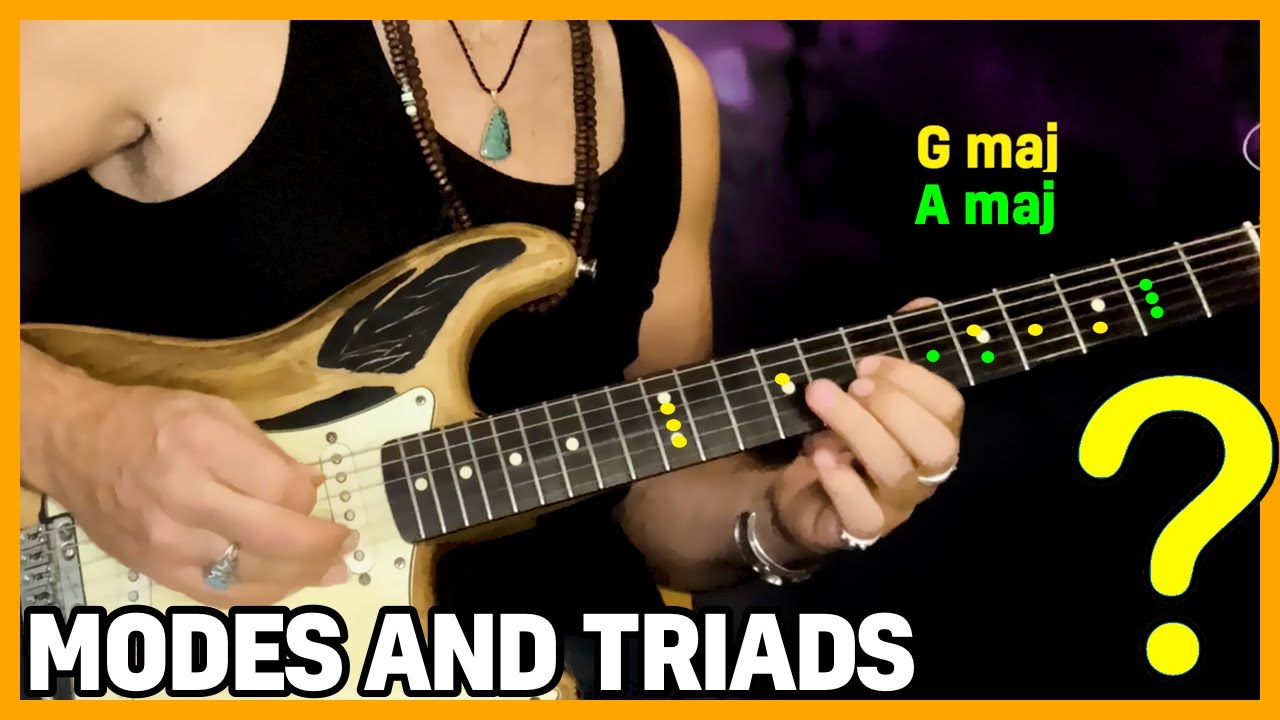
Triad Pairs - How They Can Unlock Your Improvisation On Guitar
Triad Pairs: How They Can Unlock Your Improvisation on Guitar
Have you ever listened to a guitarist play something that sounds like the pentatonic scale, but with an added richness and color you couldn't quite identify? You're probably hearing the power of triad pairs—one of the most effective yet underutilized techniques for elevating your improvisational skills.
Here's the truth: most guitarists approach modal playing by memorizing scale patterns and trying to understand modes in a "relative" context. But this method locks you into thinking about scales rather than focusing on making music. There's a better way, and it doesn't require learning new scale patterns or getting bogged down in theory.
In this comprehensive guide, we'll explore how triad pairs work, why they're so effective, and how you can start using them in your playing today—whether you're jamming at a session, performing on stage, or just practicing at home.
What Are Triad Pairs and Why They Matter
Instead of thinking about modes as complete scales, think about the core melodic elements that create their unique sound: triads. A triad pair is simply two major chords that, when played together over a root note pentatonic scale, give you the color and character of a specific mode.
Let's use a practical example. In the key of C major, you have three major triads: C major, F major, and G major. These six notes, combined with your C major pentatonic, give you nearly a complete C major scale. When you play F major and G major triads over a C drone with your C major pentatonic, you get that unmistakable C Ionian (major) sound.
The beauty of this approach? You're not thinking about scales—you're playing musically relevant chords and melodic elements. This is exactly how professional improvisers think. Instead of running scale patterns, they're using chord tones and harmonic colors to create compelling solos.
This strategy, known as triad pair playing, works because you're essentially playing the two most important chords in a given mode alongside your pentatonic foundation. For major modes, you'll use major pentatonic; for minor modes, you'll use minor pentatonic.
The Formula: Getting D Dorian and Beyond
Now let's get specific. If you want to play D Dorian, here's the formula: D minor pentatonic + F major triad + G major triad. Why? Because F major is a flat-three interval up from D (the minor third), and G major is the four.
So your Dorian triad pair formula becomes: flat three major chord + four major chord.
Let's test this with E Dorian. According to the formula, you'd play E minor pentatonic with G major and A major triads. Try it over an E drone, and you'll immediately hear that characteristic Dorian sound—it's minor but brighter than natural minor, with that perfect suspended quality.
The same principle applies to every mode. Each mode has its own specific triad pair that creates its unique sonic character. Once you learn these formulas, you can apply them in any key instantly, without memorizing new scale patterns.
Implementation: From Knowledge to Music
Here's where most guitarists fall short: they learn the theory but struggle to apply it in real musical situations. You can use triad pairs in multiple ways during improvisation:
- As full chord shapes that you strum or pick through
- As single note lines drawn from the triad's arpeggio
- As color tones mixed seamlessly into your pentatonic playing
- As rhythmic accents that emphasize the harmonic movement
The real transformation happens when you can deploy these tools instinctively—whether you're in a jam session, on stage, or recording. That's the difference between theoretical knowledge and practical mastery.
Many accomplished guitarists have found that triad pair playing accelerates their ability to improvise with modal colors without the mental burden of scale thinking. It trains your ear to recognize these harmonic relationships, and it enables you to play more musically because you're thinking in terms of chords and melody, not patterns.
If you've struggled to internalize modal sounds or felt stuck playing the same pentatonic licks, triad pairs offer a direct path forward. They bridge the gap between simple pentatonic improvisation and sophisticated modal playing—and they work in every musical genre where modal colors matter.
Ready to finally break through your plateau and master these game-changing improvisation techniques? Apply for a free strategy session and let's map out your personalized path to guitar freedom. You'll get a customized game plan designed specifically for your skill level and musical goals—just like hundreds of other guitarists who've already transformed their playing.