Blues Elements for Lead Guitar Improvisation - Pt. 3: Maj Resolution
Blues Elements for Lead Guitar Improvisation Part 3: Mastering Major Resolution
One of the most powerful techniques in blues lead guitar is knowing how to resolve your improvised lines onto the major third. If you've been grinding through blues scales and wondering why your solos sometimes feel flat or predictable, this fundamental skill might be exactly what you're missing. Landing on the major third gives your lines a sense of sophistication and intentionality that separates great blues players from average ones.
In this comprehensive guide from Total Guitar Transformation Academy, we're diving deep into how to use major resolution to transform your blues improvisation. This isn't just theory—these are practical, proven techniques that Ulrich Ellison uses in his own playing and teaches his coaching students.
Understanding the Major Third Resolution Technique
The fundamental concept here is simple but game-changing: instead of staying locked into minor pentatonic patterns all the time, you'll learn to deliberately land your improvised lines on the major third of the chord. This creates a beautiful tension and release that's essential to authentic blues soloing.
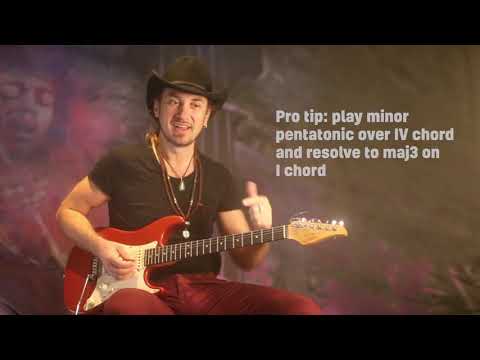
Think about how you typically approach a blues progression. You're probably playing minor pentatonic scales over the IV chord, and then when you return to the I chord, you just keep the same patterns going. But what if you could intentionally guide those patterns to resolve onto a specific note—the major third—at exactly the right moment?
The magic happens when this resolution lands on beat one of the I chord. It doesn't absolutely have to land there, but that's the most obvious and effective placement. The listener's ear expects resolution on beat one, and when you deliver it, the impact is undeniable. This is where musicality meets technical skill.
What makes this technique so powerful is that it works seamlessly when you transition from the IV chord back to the I chord. You're playing your familiar minor pentatonic shapes over the IV, but as you approach the I chord, you shift your targeting. Instead of letting your lines wander aimlessly, you guide them purposefully toward that major third interval.
The Enclosure Technique: Adding Sophistication to Your Lines
Beyond simple resolution, there's a more advanced approach called enclosure. This technique involves surrounding the target note—in this case, the major third—with chromatic or nearby notes before landing on it. Think of it as building suspense and anticipation before the resolution.
With enclosure, you might approach the major third from above and below, creating a sense of movement and exploration before finally settling on your target note. This adds layers of sophistication to your improvisation without requiring complex theory knowledge. You're simply using the space around a note to make the landing more musical and engaging.
Enclosure is one of those techniques that separates players who understand phrasing from players who just play notes. It demonstrates intentionality and control. Your audience—whether it's bandmates or a live crowd—will feel the difference, even if they can't articulate exactly what's happening musically.
Practical Application: From Theory to Your Fretboard
Here's where the rubber meets the road. The skill isn't just understanding that you can land on the major third. The real power comes from being able to play any kind of line, from any starting point, and then consciously target that major third at the right moment. That's a special ability that takes deliberate practice to develop.
Start with this foundational exercise: play your regular minor pentatonic lines over a IV-I progression, but make it your mission to hit the major third of the I chord on beat one. At first, this might feel forced or obvious. That's actually perfect. You want the concept to be crystal clear before you start making it more subtle and musical.
As you practice, you'll notice the concept becoming second nature. You'll develop an intuitive sense of which note to target and how many beats you have to guide your line toward that resolution. This is how you transition from consciously thinking about technique to simply playing music.
The practical example in the video demonstrates this clearly: starting from the beginning of a progression and deliberately timing your major third resolution to land exactly when the I chord hits. Notice how predictable it is when you're learning? That predictability becomes your foundation. Once you own this completely, you can start adding nuance, space, and musical phrasing.
Your homework is straightforward but valuable: take this little pattern and work it until it's effortless. Record yourself playing it and really listen to how it feels. Notice the moment when the resolution happens. Get comfortable with that sensation of landing intentionally on a specific note at a specific time.
Ready to finally break through your plateau and unlock these advanced blues techniques with personalized coaching? Apply for a free strategy session and let's map out your path to guitar freedom.