Stop Relying on Guitar Scales: The TGT Hendrix Method
The reason your solos sound like a robotic math exercise isn't because you don't know enough theory; it's because you've been taught to memorize patterns instead of making music. If you want to finally stop relying on guitar scales to find the "right" notes, you have to realize that the pentatonic box is often just a cage for your creativity. While "how to play guitar" is in the top 1% of educational searches on YouTube, the reality is that 90% of new players quit within their first year because they get stuck in the dry, clinical side of the instrument.
I know exactly how that feels. I've spent years staring at a fretboard that felt more like a cold crossword puzzle than a musical tool. You want your playing to have heat, movement, and that raw emotional connection that makes people stop and listen. But instead, you're stuck in the same old shapes, wondering why your solos lack that "voice" you hear in your head. It's a common ceiling, but it's one you can break through.
Here's the deal: Hendrix didn't think in scales; he thought in shapes, colors, and vocal expressions. In this guide, I'm going to show you how to break free from the "scale trap" and develop a Hendrix-inspired approach to expressive lead guitar. We are going to explore the TGT Hendrix Method, a way to bridge the gap between technical skill and personal expression so you can start playing the music you've always felt inside... starting today.
Key Takeaways
- Break the "Muscle Memory Trap" by training your ears to lead your fingers instead of just chasing geometric shapes.
- Discover how to stop relying on guitar scales by using the "Anchor Method" to find your way around the fretboard with total confidence.
- Shift from boring "Pattern-Based" runs to "Phrase-Based" storytelling using the powerful concept of call and response.
- Learn why simplifying your note choices actually unlocks more rhythmic freedom and creates a much bigger emotional impact.
- Find out why a guided transformation path is the fastest way to leave the "pentatonic box" behind and find your unique voice.
Table of Contents
-
The Invisible Cage: Why You Feel Stuck in Guitar Scale Boxes
-
Patterns vs. Phrasing: Shifting Your Focus from Shapes to Stories
-
Beyond the Fretboard: The Total Guitar Transformation Academy Path
The Invisible Cage: Why You Feel Stuck in Guitar Scale Boxes
Have you ever felt like your fingers are just running on a treadmill? You kick on a favorite backing track, start your solo, and suddenly you're just... wandering. You know the patterns. You've spent hours drilling the pentatonic shapes until your calluses are thick enough to stop a bullet. But it still sounds like a dry exercise instead of a soulful performance.
Here's the deal: You've fallen into "Scale Reliance." This is a psychological safety net that feels like home but acts like a cage, limiting your creativity to a few pre-approved frets. We've all been there. I remember spending months just "running the stairs" up and down the neck, hoping a melody would magically appear. It never did because I was trapped in my own head.
The real culprit is the "Muscle Memory Trap." Your fingers have taken over the steering wheel before your ears even have a chance to listen. You're playing with your eyes and your habits, not your heart. This isn't your fault, though. Traditional guitar education is obsessed with shapes. Most lessons give you a map but never teach you how to enjoy the scenery. To truly stop relying on guitar scales, you have to realize that the box isn't a tool; it's a crutch that keeps your musical voice quiet.
The Symptoms of Scale-y Playing
Does it feel like you're just "painting by numbers" every time you pick up the pick? Maybe you can play fast, but you can't find the "right" notes the second the backing track moves to a new chord. You feel frustrated because your solos lack that vocal, crying quality you hear in your heroes. The Scale Trap is simply the painful gap between your technical knowledge and your musical soul.
You might notice these signs in your own playing:
-
Your solos always start and end on the same root note.
-
You feel "lost" if you move two inches outside of your favorite box.
-
Every lick you play sounds like a variation of the same three patterns.
The Fear of the "Wrong" Note
Scales feel safe because they offer the illusion that every note in the pattern is "good." But if every note is equally good, then no note is truly special. This safety net is exactly what prevents you from taking the risks that define true blues expression. Hendrix wasn't worried about being "correct" in a theoretical sense. He was focused on being intentional with every vibration.
True music happens when a sequence of notes forms a complete musical sense of its own. It's about shifting your focus from "which note is allowed" to "which note do I actually want to hear?" When you stop playing the pattern and start playing the story, the fear of the "wrong" note simply disappears. You start to see the fretboard not as a series of traps, but as a landscape of emotional possibilities.
The Science of Sounding 'Scaley' (And How to Break It)
Most "gurus" on YouTube tell you that the fix for boring solos is to learn "diagonal pentatonics" or more complex modes. Here is the problem: a new pattern is still just a pattern. It is another box with a different shape. To stop relying on guitar scales, you have to understand why the human ear tunes out the moment you start running up and down a fretboard grid. It comes down to predictability.
Our brains are wired to recognize patterns. Once the listener's brain realizes you are just playing a mathematical sequence, it stops listening. It is like someone reading a grocery list out loud; the information is there, but there is no soul in it. Scale runs are predictable. They move in the same direction with the same intervals, which is the musical equivalent of a "spoiler alert" for your solo.
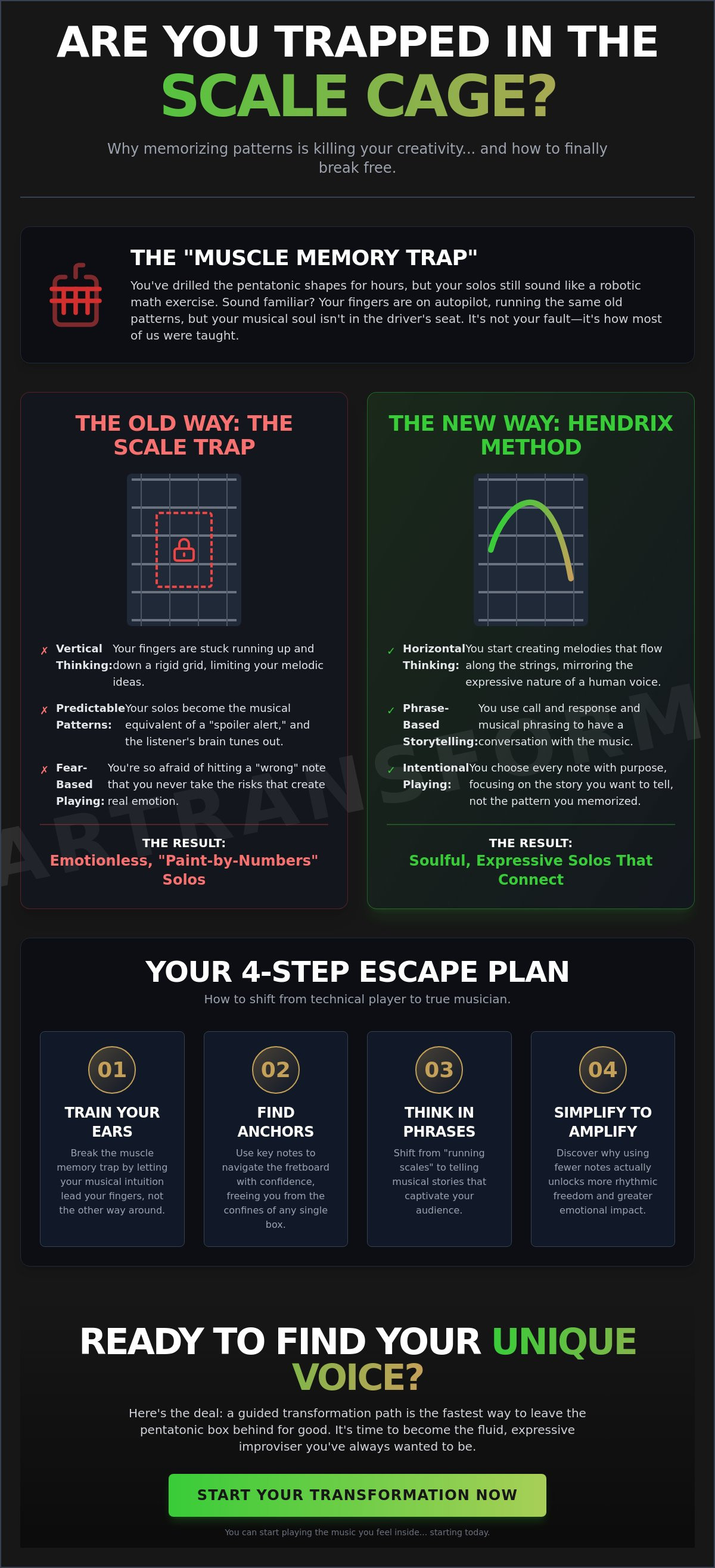
If you want to break this habit, you need to shift from "Vertical Thinking" to "Horizontal Thinking." Most players look at the neck as a vertical grid of six strings. This keeps you trapped in one spot. Vocalists and horn players think horizontally along a single melody line. When you start moving up and down a single string, you mirror the range and sliding nature of a human voice. You stop seeing shapes and start seeing the emotional distance between notes, also known as intervals. If you feel like you are ready to move past the grid and start playing with real intent, you can apply to join our community of players who are doing exactly that.
Rhythm: The Forgotten Element of Lead Guitar
You can play a single note and make an entire room go silent if you hit it with the right "pocket." Most scale-heavy players suffer from a "constant stream" of notes. They play eighth note after eighth note with no breaks. It is exhausting to listen to. By using syncopation and varying your note lengths, you break the predictable cycle of the scale. Remember this: silence is actually the most powerful "note" in a blues solo. It provides the tension and release that makes the next note feel like a relief.
The Vocal Connection: Sing What You Play
Hendrix was a master of the vocal connection. His guitar didn't just play notes; it talked. You can replicate this with the "Hum and Play" exercise. Try humming a simple, four-note melody before you touch the strings. Then, find those exact notes on your fretboard. This forces your brain to lead your fingers, rather than letting your muscle memory take over. It bridges the gap between your inner musical ear and your hand, ensuring your solos follow the natural cadence of a human voice instead of a pre-set pattern.
Patterns vs. Phrasing: Shifting Your Focus from Shapes to Stories
Flashback to my first real gig: I played every note in the pentatonic box perfectly, but the audience looked like they were waiting for a bus. I was technically "correct," but I was boring. Why? Because I was playing shapes, not stories. Most guitarists treat a solo like a math test where they have to use every number in the box, but if you want to stop relying on guitar scales, you have to start thinking in phrases rather than patterns.
Pattern-based playing is robotic. It is what happens when your fingers move because they "know" where the next fret is. Phrase-based playing is a conversation. Think of it as "Call and Response." You play a short musical "question," then you answer it. This builds a connection with your listener because you are actually saying something instead of just filling space with noise.
Here's the deal: Great blues-rock is 10% scale and 90% inflection. It is not about the notes you choose; it is about how you treat them. You could play the exact same three notes as Hendrix, but without the right bends, vibrato, and slides, it will sound like a ringtone. You need to target "Chord Tones," which are the secret notes that make you sound like you actually know where the song is going. When you land on a chord tone, the listener feels a sense of relief and resolution.
Building a Musical Narrative
Every great solo has a beginning, a middle, and an end. You start with an intro to set the mood, build conflict through tension and speed, and finally provide a resolution that brings the listener home. You can do this through "Motivic Development," which is just taking one cool little idea and repeating it with slight changes. It keeps the listener engaged without you ever needing to change scales. If you are ready to find your own "voice" on the instrument, check out our full TGT System .
The Power of Inflection
Your vibrato is your musical signature. If yours sounds thin or nervous, it is likely because you are still thinking about the scale pattern instead of the "feel" of the note. You have to learn to bend into the "Blue Note," those tiny microtones that live between the frets. This is where the magic happens. Hendrix also loved using double-stops to add harmonic depth. By playing two notes at once, he created a massive, piano-like sound that moved far beyond the limitations of "scale-y" single notes. It is about adding heat and movement to every single vibration.
4 Steps to Hendrix-Inspired Freedom Without Heavy Theory
Most players think they need more notes to sound better. But Hendrix could do more with a single string than most people can do with a whole rack of guitars. If you're ready to stop relying on guitar scales, you have to embrace the power of limitation. Here is the four-step roadmap to finding that elusive Hendrix feel without drowning in a sea of theory.
-
Step 1: Simplify. Pick just three notes from your favorite key. Your only job is to master their rhythm and placement before you even look at the rest of the neck.
-
Step 2: The 'Anchor' Method. Learn to identify your root note in every single position on the fretboard. Once you know where your "home" is, you don't need the walls of a box to keep you safe.
-
Step 3: Embellish. Take those same three notes and add the "Hendrix sauce." We are talking about aggressive slides, percussive hammer-ons, and those greasy pull-offs that make the guitar growl.
-
Step 4: Connect. Use what I call the 'Hendrix Glide' to slide between your positions organically. Instead of jumping from Box 1 to Box 2, you'll learn to glide through the "in-between" spaces that most players ignore.
So, why does this work? Because it forces you to actually listen to what you're playing. If you're tired of guessing and want a roadmap to this kind of musical liberty, apply to work with me inside the Academy so we can unlock your inner Hendrix together.
The 'Three-Note' Challenge
I want you to try a little experiment. Limit yourself to just three frets on one string and try to play a solo for two minutes. It sounds like a nightmare, right? But this exercise forces you to find 20 different "vibes" using nothing but your touch and timing. Musical Economy is the art of doing more with less, squeezing every drop of emotion out of a single vibration before you move on.
Navigating the Fretboard by Ear
To play like Jimi, you have to start using "Interval Recognition" instead of memorizing "Box Shapes." Think of the fretboard as a landscape of sounds rather than a grid of dots. Try the 'One-String Solo' exercise to break your vertical box habit once and for all. When you can play a melody up and down a single string, you start to see the connections that were always hidden by the traditional scale shapes. It's about moving from a state of thinking to a state of feeling. Lol, it sounds simple, but it's the most transformative shift you'll ever make.
Beyond the Fretboard: The Total Guitar Transformation Academy Path
You've probably spent hours on Reddit or YouTube trying to piece together a "pro" sound from 10-minute tutorials. It's a disaster for most players because you end up with a library of licks but no way to connect them. If you really want to stop relying on guitar scales, you need a structured environment where your progress isn't left to chance.
That is why I created the Total Guitar Transformation (TGT Academy). It is an invite-only, 12-month mentorship designed to take you from "pattern-bound" to a fluid improviser. Here's the deal: You don't need more information; you need the right transformation. We've helped hundreds of players reclaim their musical joy by focusing on the "language" of the guitar rather than the math of the fretboard.
Take my student Dave, for example. He’d been stuck in the "pentatonic box" for over 15 years and felt like he’d hit a permanent ceiling. Fast forward to today: After just 90 days in the Academy, Dave was finally improvising soulful, Hendrix-inspired solos over a slow blues without even thinking about his finger positions. Lol, he told me it felt like he’d finally found the "on" switch for his creativity.
The Value of Expert Feedback
The biggest hurdle in self-study is the lack of a mirror. You can't hear the "stiffness" in your own phrasing or the slight timing issues that make your solos sound "scaley." In the Academy, every single homework task you submit gets personalized feedback. You are being personally mentored by ME and my team of touring professionals to ensure your "blind spots" are cleared away for good.
This isn't just about learning licks; it's about shifting your entire musical identity. Check out some of our other student results to see what is possible when you have a pro in your corner. When you have someone to catch your mistakes in real-time, you stop guessing and start growing.
Your 12-Month Roadmap to Mastery
Our curriculum is built specifically for adults who want to master the "Hendrix feel" without the dry, academic jargon. We move through stages of growth that prioritize your unique musical voice over technical perfection. By the time you finish the program, you won't just be playing notes; you'll be telling stories. Join Total Guitar Transformation (TGT Academy) and find your voice.
Your biggest fan,
Ulrich Ellison
P.S. You've spent enough time wandering the "box" cage. It's time to step out and play the music you were meant to play. Let's do this.
Ready to Find Your Real Voice?
You've spent years following the rules and staying inside the lines of the pentatonic box. But as we've discussed, the path to true musical freedom isn't found in another pattern or a faster scale run. It's found when you finally decide to stop relying on guitar scales and start trusting your own musical ear to lead the way.
If you are ready to leave the "safety net" behind for good, I'd love to help you bridge that gap. The Total Guitar Transformation (TGT Academy) is a specialized 12-month curriculum built specifically for adults who want real results without the academic fluff. You won't be guessing anymore; you'll be growing with a clear roadmap and personalized feedback on every single homework task, personally mentored by ME.
Apply for the Total Guitar Transformation (TGT Academy) today and let's turn those robotic runs into soulful solos. I've seen hundreds of players just like you finally "click" with the instrument, and I know you have that same breakthrough waiting inside you.
Your biggest fan,
Ulrich Ellison
P.S. Spots in the Academy are limited because I personally review your progress to ensure you succeed. Don't wait until next year to finally find your soul on the fretboard.
Frequently Asked Questions
How do I stop my solos from sounding like I'm just practicing scales?
You fix the "scaley" sound by focusing on the space between the notes rather than just the notes themselves. Most players fail because they treat a solo like a constant stream of information with no room for the listener to breathe. If you want to stop relying on guitar scales, try to play a short phrase and then physically take a breath before playing the next one. This simple shift forces you to think like a singer rather than a mathematician.
Is it possible to play lead guitar without knowing music theory?
It is totally possible because playing guitar is a language, not a math equation. Hendrix didn't need a degree to change the world; he used his ears to find the heat and movement in every note. While some theory is helpful, we prioritize "Skill over Theory" in our Academy to ensure you get soulful results without getting bogged down in academic jargon.
Why is the pentatonic box so hard to break out of?
The pentatonic box is a psychological safety net that creates a visual cage on your fretboard. It feels safe because you know you won't hit a "wrong" note, but that safety is exactly what kills your creativity. Your muscle memory takes over before your musical mind can even start a conversation. To break out, you have to stop looking at the grid and start listening to the intervals between the notes.
What is the 'Hendrix-inspired' method for guitar?
The Hendrix-inspired method is a way of seeing the fretboard where chords and leads are essentially the same thing. Instead of running up and down patterns, you learn to "decorate" the chord shapes you already know with double-stops and vocal-like inflections. It is about treating the guitar like a human voice. This is the core of what we teach inside the Total Guitar Transformation (TGT Academy) to help you find your unique voice.
Can I learn to improvise soulful solos if I'm over 50?
Absolutely. In fact, our most successful students are in the 45-70+ age range because they have the life experience to put real emotion into their playing. You have the emotional depth to tell a story through your strings that a teenager just hasn't lived yet. All you need is a mentor to help you translate those feelings into "fluid improviser" skills.
What should I practice instead of scales every day?
You should practice the "Sing-What-You-Play" exercise and one-string melody navigation. Instead of mindlessly drilling Box 1, try to find a simple melody on a single string and then add slides and vibrato. This builds the "vocal connection" between your inner ear and your fingers. It is much more effective to master three notes with perfect inflection than to play a hundred notes with zero soul.
How long does it take to stop relying on scales?
Most of our students experience a "lightbulb moment" within their first few weeks of structured practice. Fast forward to today: I've personally mentored countless players who spent decades stuck in the boxes but finally found their unique voice in under a year. If you follow the roadmap, you will start to stop relying on guitar scales for your musical identity in about 90 days or less.
Do I need to learn all 5 positions of the pentatonic scale?
Knowing all five positions is fine, but it often just gives you five different cages to get stuck in. It is far more important to learn how to connect two positions horizontally than to memorize all five vertically. Hendrix often stayed in one or two "home" areas but moved between them with such fluidity that it sounded like he owned the entire neck. Focus on the escape routes, not just the boxes.